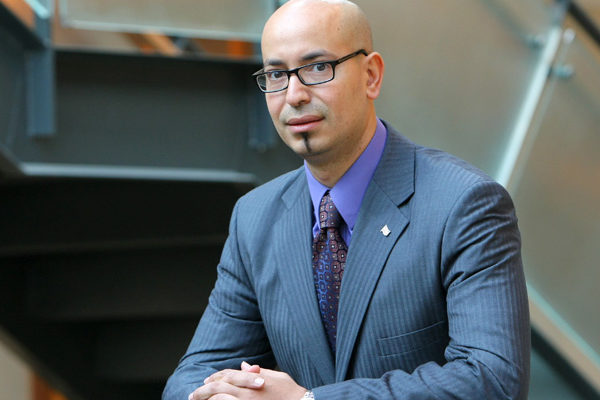

For Oluwadamilare “Dami” Sodeinde, the process of finding his place in new environments began long before he arrived in Canada.
Born in Abuja, Nigeria, Dami spent a significant part of his childhood adapting to different places as his parents’ careers required the family to relocate every five or six years. Those experiences taught him early on how to adjust to unfamiliar surroundings and build new relationships.
“I think that helped me become comfortable with change to a good extent,” he says. “I learned that I could walk into a new environment where I don’t know anybody, and I could still find a way to build relationships and create a sense of belonging wherever I am.”
That ability to find connection would become especially important when Dami later left Nigeria to pursue post-secondary education in Canada.
Today, Dami is completing his final year at Mount Saint Vincent University, where he is studying economics with minors in political science and business administration. His academic achievements have earned him awards and recognition from both the university and the broader community.
As an international student, however, Dami quickly realized that his education would extend far beyond the classroom. His journey would also involve navigating a different educational system, adjusting to a new culture, and building a support network where he could find both opportunities and a sense of belonging.
Over time, that journey has transformed Dami into a community builder—someone who now helps create the sense of belonging he once sought for himself.
Dami’s decision to pursue an international education began during high school in Nigeria.
“I was the top business student in my class,” he says. “I generally gravitated towards economics and accounting because I just understood it. I loved how money worked, business and economies, and I just enjoyed it.”
With his academic interests already established and his plans to study internationally firmly in place, Dami arrived in Canada ready to begin a new chapter. What he encountered, however, was more complex than he had imagined.
There were financial pressures, cultural adjustments, and the challenge of building a network from the ground up. For Dami, there were also experiences of racial discrimination.
“As a Black guy from Nigeria, the racial stereotypes are still very much evident within Canadian society,” he says.
One of the challenges he identifies is deeply personal: his name.
“I don’t have an English name,” he says. “My parents didn’t want to; they didn’t see a need to give me an English name.”
Dami believes that having a traditional Nigerian name can sometimes create additional barriers when seeking employment. He says he has encountered people who choose to use more common English names professionally because of similar concerns.
The contrast between his expectations and experiences has allowed Dami to reflect more deeply on his journey in Canada and to celebrate his accomplishments while remaining honest about the challenges he has faced.
“It taught me that you can be grateful for an opportunity whilst being honest about the difficulties that come with it,” he says.
Another significant adjustment came during Dami’s first semester. Despite having been at the top of his high school class, he quickly discovered that the Canadian educational system operated differently from what he was accustomed to.
“I would get back from school, open up an assignment and be totally confused about what they wanted me to do,” he recalls.
At times, the frustration became overwhelming. But through persistence, trial and error, and continuous effort, he gradually learned how to navigate the expectations of his new academic environment and improve his work.
The experience taught him a lesson he believes is particularly important for other international students: needing help does not mean you are failing.
Universities have resources available to support students with different needs and experiences. For Dami, learning to access those resources became an important part of his own transition. In time, he would move beyond receiving support and begin taking leadership roles in some of those same spaces.
As he adapted to his new academic environment, Dami also began searching for something equally important: community.
Rather than simply waiting to find it, he began helping to build it.
His experience with the Black Student Support Office eventually led him to volunteer with the Black Student Society. Working alongside his peers, he helped strengthen and develop the student society, first serving as Operations Manager before becoming Vice President.
For Dami, his motivation was rooted in his own experiences as a newcomer.
“Having a space where you don’t constantly have to explain your background or your perspective creates a different kind of comfort,” he says.
The goal is simple but meaningful: to help create the kind of environment he wishes he had when he first arrived.
“The idea is just to create that home-away-from-home sense for people who are coming to the country,” he says.
Within the classroom, Dami’s academic and professional ambitions remain equally strong.
“Economics, politics, finance, business, whatever it may be, aren’t really separate worlds,” he explains. “They constantly influence one another.”
His experience as an international student has made those connections especially tangible. Studying economics and politics while simultaneously navigating immigration, education, employment, identity, and community in a new country has given him a perspective that extends beyond textbooks and lectures.
His academic achievements reflect that commitment.
Dami was recently honoured with the Academic Excellence in Economics Prize, the Andrea and Charles Bronfman Award in Canadian Studies, and the Marial Mosher Award in Canadian Studies at Mount Saint Vincent University.
He takes pride in those accomplishments, but also connects them to a deep sense of responsibility and gratitude toward his family.
“I made a promise to my parents before I came to the country,” he says. “I told them that I know these international fees and tuition might be a strain on you, but I promised that I would get the best out of it.”
Toward the end of his interview, Dami shares an unexpected idea that brings together many of the different chapters of his story.
He turns to grammar—more specifically, the mobility of adverbials: the ability of an adverbial to move within a sentence while the sentence continues to make sense.
For Dami, the grammatical concept has become a metaphor for navigating life.
“No matter where you are, just remain useful,” he says. “Remain functional.”
He compares people to an adverbial that can move within a sentence and continue to contribute meaning wherever it is placed.
“Be like an adverb that remains useful wherever they’re kept,” he says.
It is an unexpected metaphor, but perhaps one that captures Dami’s journey better than almost anything else.
He has spent much of his life learning how to move and adapt—from Abuja to different parts of Nigeria, from Nigeria to Canada, from one educational system to another, and from being a newcomer searching for community to becoming someone who helps create it.Through each transition, Dami has found ways to remain grounded in his purpose while making space for others along the way. His journey is not simply about adapting to a new country or succeeding academically. It is about understanding that belonging can be both something we search for and something we intentionally create for others.